
WHAT VOGUE-PUBLISHED WEDDING PHOTOGRAPHERS DO DIFFERENTLY
Our work has appeared in British Vogue, Vogue Arabia, Vogue Australia Weddings, and Tatler. We photograph across Portugal, Italy, France, and throughout Europe, on digital, film, and Super 8, and we take no more than ten weddings a year. Those aren't credentials we place at the bottom of a page. They shape every decision we make on a wedding day, from how we read a room to where we choose to stand.
This article is not about reputation. It is about what actually changes when a magazine like Vogue becomes your standard of reference, and why that matters for the couple in front of the camera.
What "editorial" actually means in practice
The word editorial gets used loosely in wedding photography. It often means little more than clean backgrounds and good light. What it actually refers to is something more specific: a way of framing reality that produces images capable of holding attention on a printed page, without the caption, without context.
An editorial image earns its place without explanation. A well-composed photograph of a bride smiling at the camera is a beautiful image. An editorial image of the same bride might show her from the side, eyes closed, one hand resting on her bouquet, the light from a Baroque window cutting across her dress while a reflection catches something in the background that the eye notices only on second look. Both images are technically competent. Only one has an interior life.
The difference is not in the equipment. It is not in the editing. It lies in how the photographer reads the space, the light, and the moment before pressing the shutter. Editorial photographers don't look for the obvious version of a shot. We look for the version that would stop a page turn.
That level of visual specificity is not about style. It is about attention and intention, and it is what separates images that document a day from images that interpret one.
How being published changes the way we approach a wedding day
When a set of images has been edited for a major fashion or lifestyle publication, those editors are not asking themselves whether the day looked beautiful. They are asking whether each image has a reason to exist. Whether it adds something to the image or not. Whether the sequence tells a story that moves.
That standard becomes a permanent part of how we see.
At the wedding of Hessah and Ali at Palácio de Queluz, published in Vogue Arabia, the ceremony took place in the palace gardens with the 18th-century Cascade as backdrop, a string quartet in pale pink dresses performing along the aisle, and late-afternoon light coming in from the west. Most photographers would have focused on the key moments: the processional, the vows, the kiss, the recessional. We were watching the layering. How the Cascade monument created a natural frame for the couple. How the shadow from the boxwood hedges fell across the rows of chairs at an angle. How guests holding white paper parasols formed graphic shapes against the warm stone.
The result was a set of images that, when submitted to Vogue Arabia, did not need to be explained. They worked as images, not as records.
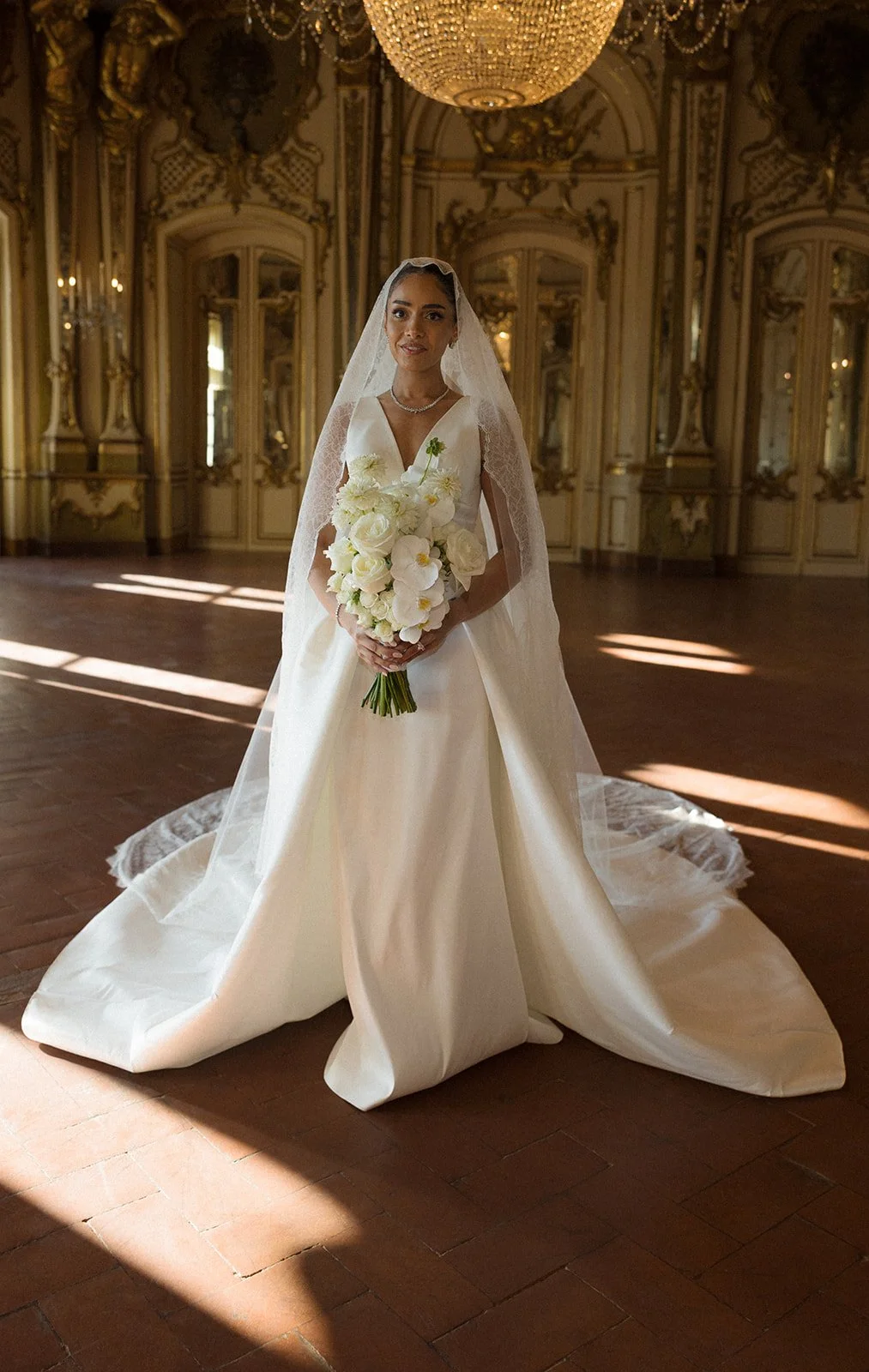
That reading doesn't happen by accident. It comes from having trained your eye against a high standard, and from choosing, every time, to photograph what is true rather than what is expected.
What we look for that most photographers miss
There is a set of moments that exists in every wedding and goes unphotographed in most. Not because these moments are hidden, but because they require slowing down enough to notice them.
A bride and her father pause at the threshold of the ceremony space. Not the moment they enter, but the two seconds before, when nothing has happened yet. The way light from a garden doorway divides a reception room in half, one side warm, one side in shadow. The shift in atmosphere between one hour and the next as the day moves from ceremony to cocktail to dinner, and the guests who change with it. The texture of a marble column against the soft focus of a garden beyond it.
We photograph transitions. The moments between the official moments, which is where the emotional truth of a day tends to live. A string quartet finishing its last piece and beginning to pack away. Guests moving through formal gardens toward the palace, seen from behind in long late-afternoon shadows. A bride walking alone for sixty seconds, not toward anything in particular, just existing in the space she's chosen for one of the most significant days of her life.
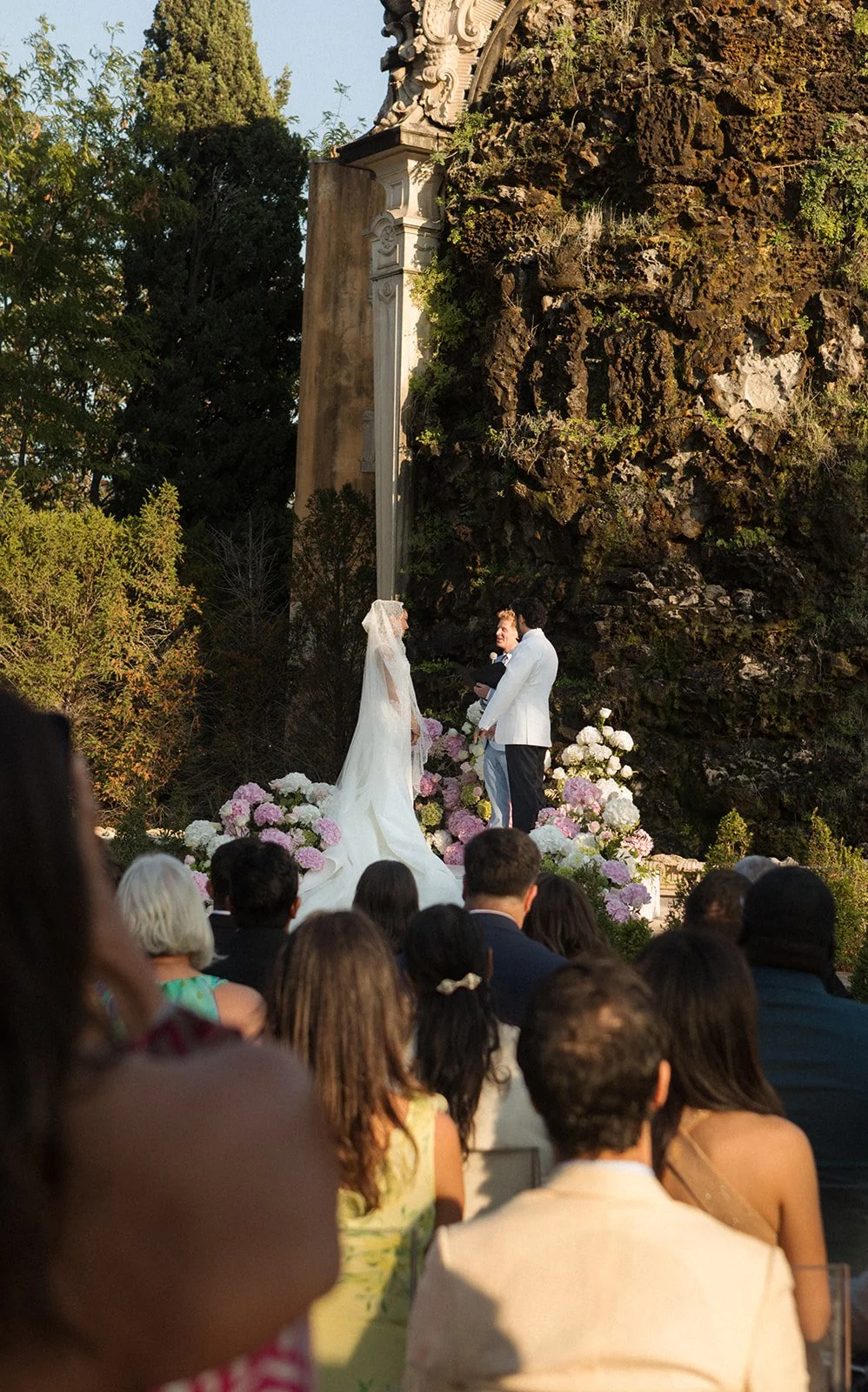
These are the images that couples return to years later. Not because they are technically superior to the portraits. Because they are true.
What this means for your wedding day experience
The way we photograph has a direct effect on how the day feels, not just how it looks.
We don't position people unless we have a clear reason to. We don't move couples to better-lit locations and ask them to hold still; we wait for the light to come to where people naturally are, or we find the moment when natural movement and natural light intersect. We don't spend twenty minutes arranging a group photograph when the group has already arranged itself into something worth photographing.
On a practical level, this produces a calmer day. Couples we work with almost always tell us afterward that they forgot we were there for long portions of it. That is not an accident. The more a photographer announces their presence, the more the couple performs rather than experiences. Our job is to remove that pressure.
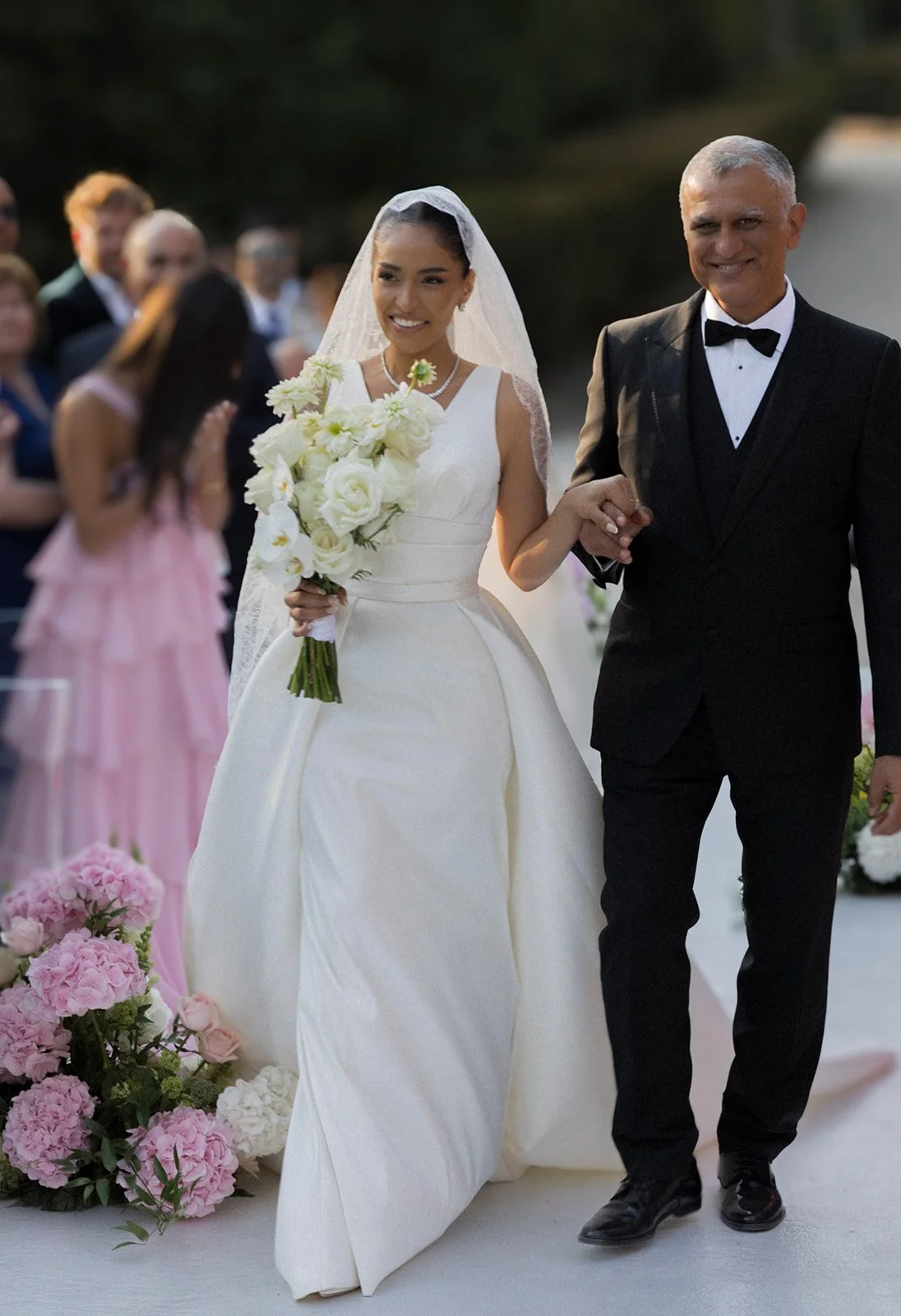
We are also honest about what requires direction. Portrait sessions work better when we are active, specific, and efficient. Ceremony and reception work best when we disappear entirely. Knowing the difference and transitioning between the two without friction comes from photographing a high volume of weddings at a consistently high level over many years.
The result is a gallery that reflects the actual day rather than a directed version of it.
What Vogue-level photography actually requires
The publications we work with hold their visual standards regardless of whether the wedding took place in a palace or a private estate. What matters is the quality of the observation, the internal consistency of the edit, and the coherence of the gallery as a whole.
That coherence is what makes this work difficult to produce at scale, and why we limit our calendar to ten weddings a year. Reading a venue properly takes time before the day. Understanding how light moves through the Palácio de Queluz gardens across an August afternoon, where the shadows from the topiary fall at five o'clock, which arcades produce the natural frames we'll want in the hour before dinner: that preparation doesn't happen in a morning.
It also requires that editing remain entirely internal. We do not outsource any part of the edit. Every image we deliver has been seen and processed by the same eyes that made it, which is the only way to guarantee that the visual logic of a day holds from the first frame to the last.
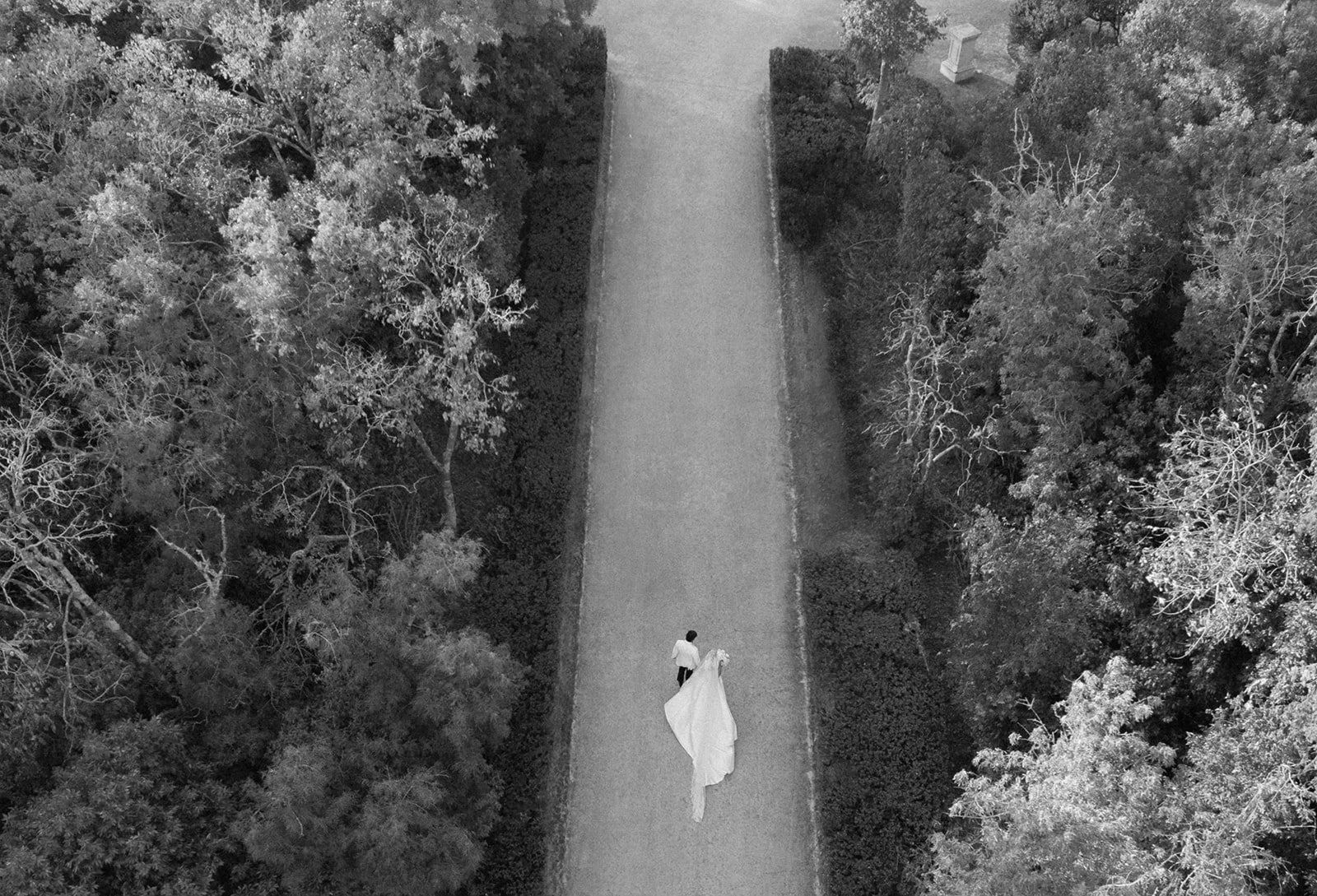
We photograph on digital, film, and Super 8. Each medium contributes something the others don't, and using all three across a wedding day produces a gallery with a range and texture that a single format cannot replicate. The Super 8 footage from Hessah and Ali's day at Queluz reads like archive material already, which is partly what Vogue Arabia responded to.
You can read more about who we are and how we came to work this way on our About page.
Frequently Asked Questions
What does it mean for a wedding photographer to be published in Vogue?
Publication in a magazine like Vogue is an editorial selection, not a paid placement. The magazine's team accepts or rejects submissions based on the visual quality of the photography, the originality of the work, and the coherence of the images as a set. A photographer whose work appears in British Vogue, Vogue Arabia, or a comparable title has had their images measured against the visual standards of one of the most demanding publishing environments in the world. It reflects the quality of the photography itself, not the prestige of the venue or the budget of the wedding.
How do I know if a photographer shoots at an editorial level?
Look at their galleries as sequences, not individual images. A photographer working at an editorial level produces work where each frame adds something the previous one did not. You will find photographs of moments between moments: transitions, textures, and environmental details that anchor the day within its specific location. You will also notice restraint in the portraits, a quality of observation rather than performance. If the images could appear in a high-end print publication without alteration, that is a reliable indicator.
Does being published in Vogue make a photographer more expensive?
Not automatically, but the conditions that make Vogue-level work possible tend to come from photographers who have chosen low volume, high standards, and a process that does not compress easily. Those choices are reflected in pricing. A photographer who accepts forty weddings a year cannot offer the same depth of preparation or quality of attention as one who accepts ten. For a more detailed breakdown of what the investment covers, read our article on what you actually get from a $10,000 wedding photographer.
Is editorial wedding photography right for every couple?
No. Editorial photography prioritizes visual truth and the photographer's interpretation of the day over comprehensive documentation. Couples who want every family group recorded and every moment of the day accounted for may find a documentary approach more aligned with what they need. Editorial work is for couples who want a body of images with a clear point of view, and who are comfortable trusting the photographer's judgment about which moments matter most.
