
WEDDING VENUES IN NORTHERN PORTUGAL: DOURO VALLEY, PORTO AND MINHO
After photographing more than sixty weddings across Portugal, Italy, and France, and with work published in British Vogue, Vogue Arabia, and Tatler, we have developed a clear understanding of why northern Portugal requires a different photographic approach from the rest of the country. The distinction is not quality. It is geometry.
Portugal's western Atlantic coastline and its flat southern plains produce open, horizon-to-horizon golden hours. Northern Portugal does not. The Douro Valley, the Lima Valley, and the hillsides above Porto are enclosed by terrain. The sun descends over the western hills before it reaches the water. That has specific consequences for ceremony timing, for the quality of evening light, and for where the most useful natural light comes from at each property.
That is not a disadvantage. It is a different set of conditions. The venues below are worth choosing precisely because of how their light behaves, not despite it.
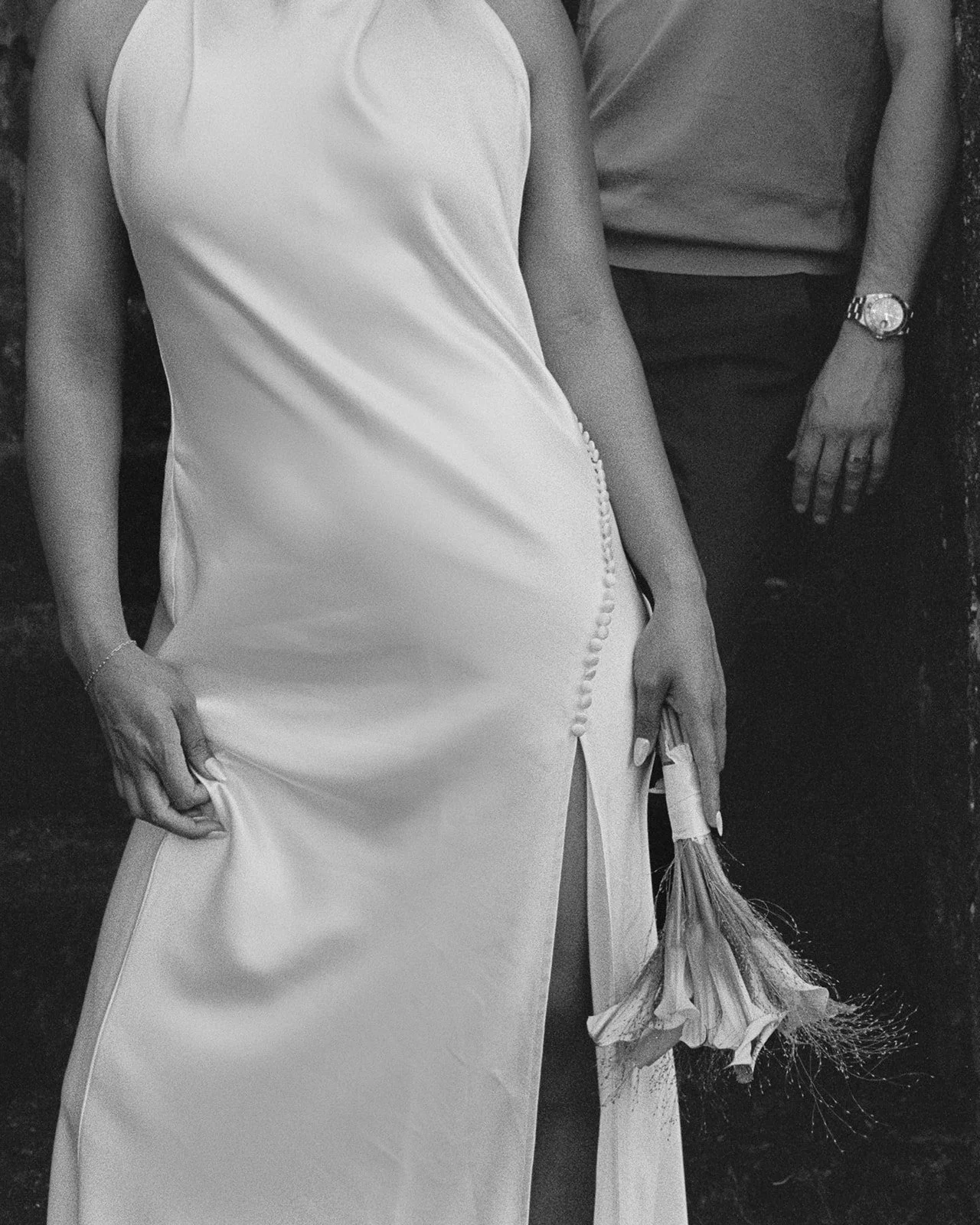
What Valley Light Means for Wedding Photography
The morning light in northern Portugal's river valleys is often the strongest photography window of the day. River fog over the Douro at dawn, soft diffused light before the sun clears the eastern hills, stone architecture that holds shade until mid-morning. These are the conditions that produce photography specific to this landscape. The evening golden hour in the north arrives earlier than on the Atlantic coast, sometimes as the sun reaches the western hilltops rather than the horizon, which means portrait sessions timed to 3 pm to 5 pm in autumn frequently perform better than sessions timed to 6 pm or 7 pm.
Each of the venues below has a specific relationship with the light available at its location. Some face south and receive direct afternoon light across an open valley. Some work best within a cloister or interior courtyard. The Douro Valley vineyards photograph well from early morning until early afternoon, when the sun is still clearing the eastern ridgeline and the terraced hillsides receive low-angle light from the east.
This contrasts with the west-facing Atlantic venues that produce the strongest evening light in Portugal. For a comparison of those properties, our guide to the best natural light wedding venues in Portugal covers the criteria and venues in detail.
Six Senses Douro Valley, Lamego
Six Senses Douro Valley is the strongest luxury hotel option in the northern wine country for destination weddings. The property is a 19th-century manor house in Samodães, near Lamego, within the UNESCO World Heritage Douro wine region, on a south-facing hillside above the river. Porto Airport is approximately 135 kilometers away.
The south-facing orientation is the key photographic characteristic. Afternoon light arrives directly at the property's terraces and vineyard settings before the surrounding western hills intercept the descending sun. Ceremony and portrait timing between 3 pm and 5 pm in September and October works consistently here. The estate has multiple ceremony locations including outdoor terraces overlooking the valley, vineyard settings, and a greenhouse event space.
The hotel has 71 rooms and suites. Events with more than 80 guests require a minimum two-night full property buyout. Maximum capacity is 250 guests.
Quinta do Vallado, Régua
Quinta do Vallado was established in 1716 on the banks of the Corgo River, a tributary of the Douro, close to Peso da Régua. It is one of the oldest wine estates in the valley and has remained in the family of Dona Antónia Adelaide Ferreira, the figure who shaped much of the Douro's modern wine production in the 19th century.
The estate has 19 guest rooms across three building types: the original Traditional House, a Modern Building, and six Eira Suites. Over 70 hectares of vineyards surround the property, and the wine cellar accommodates intimate dinners and tastings.
For a working wine estate at valley floor level, the morning is the strongest photography window. The east-facing slopes catch the first light of the day, and the river mist that sits on the Corgo and Douro in cooler months produces atmospheric photographs before 10 am that are not replicable at other times of day. The stone architecture of the Traditional House responds well to the low, warm morning light that arrives from the east before the valley fully illuminates.
Pestana Palácio do Freixo, Porto
Pestana Palácio do Freixo sits on the north bank of the Douro River in Campanhã, within 10 minutes of Porto's city center. It was designed by Nicolau Nasoni in 1742, the architect behind Porto's Clérigos Tower and the Porto Cathedral, and has been a National Monument since 1910.
The building connects to approximately 10,000 square meters of formal terraced gardens that descend toward the river. The Douro in this section flows from east to west before bending south. The gardens face the river with a south-southeast orientation, and the river surface reflects afternoon light back toward the terraces. This reflected fill is a specific characteristic of the Freixo's position on the waterfront and produces a secondary light quality that straight garden venues without water views do not have.
The property has 87 rooms and suites and can accommodate events of over 300 guests. Porto adds a dimension that standalone country venues do not: the city is immediately accessible, which makes multi-day celebrations based at the Freixo practical in a way that more remote properties are not.
Paço de Calheiros, Ponte de Lima
Paço de Calheiros is a 17th-century manor house on a hillside 7 kilometers from Ponte de Lima, in the Lima Valley. It is the home of the Count of Calheiros and has served as a rural accommodation and event property. The Lima Valley below is visible from the property, including the Roman bridge of Ponte de Lima on clear days.
The manor has 9 guest rooms and 6 apartments. An on-site chapel accommodates religious ceremonies. The estate sits within Vinho Verde wine country and produces wine from its own vineyards.
The photographic advantage of Paço de Calheiros is its hillside position and south-facing aspect over the valley. The Lima Valley faces generally east-west, and the elevated south-facing orientation means afternoon light arrives directly at the stone facades and gardens without the valley floor shadow that affects flatter, lower-lying properties. This is one of the more favorably oriented manor properties in the Minho for afternoon portrait sessions.
Ponte de Lima is approximately 80 kilometers north of Porto via the A3.
Mosteiro de Landim, Famalicão
Mosteiro de Landim is a 12th-century monastery near Vila Nova de Famalicão, approximately 25 to 30 minutes north of Porto. It is a National Heritage site and functions as a family-run event venue and working Vinho Verde wine farm.
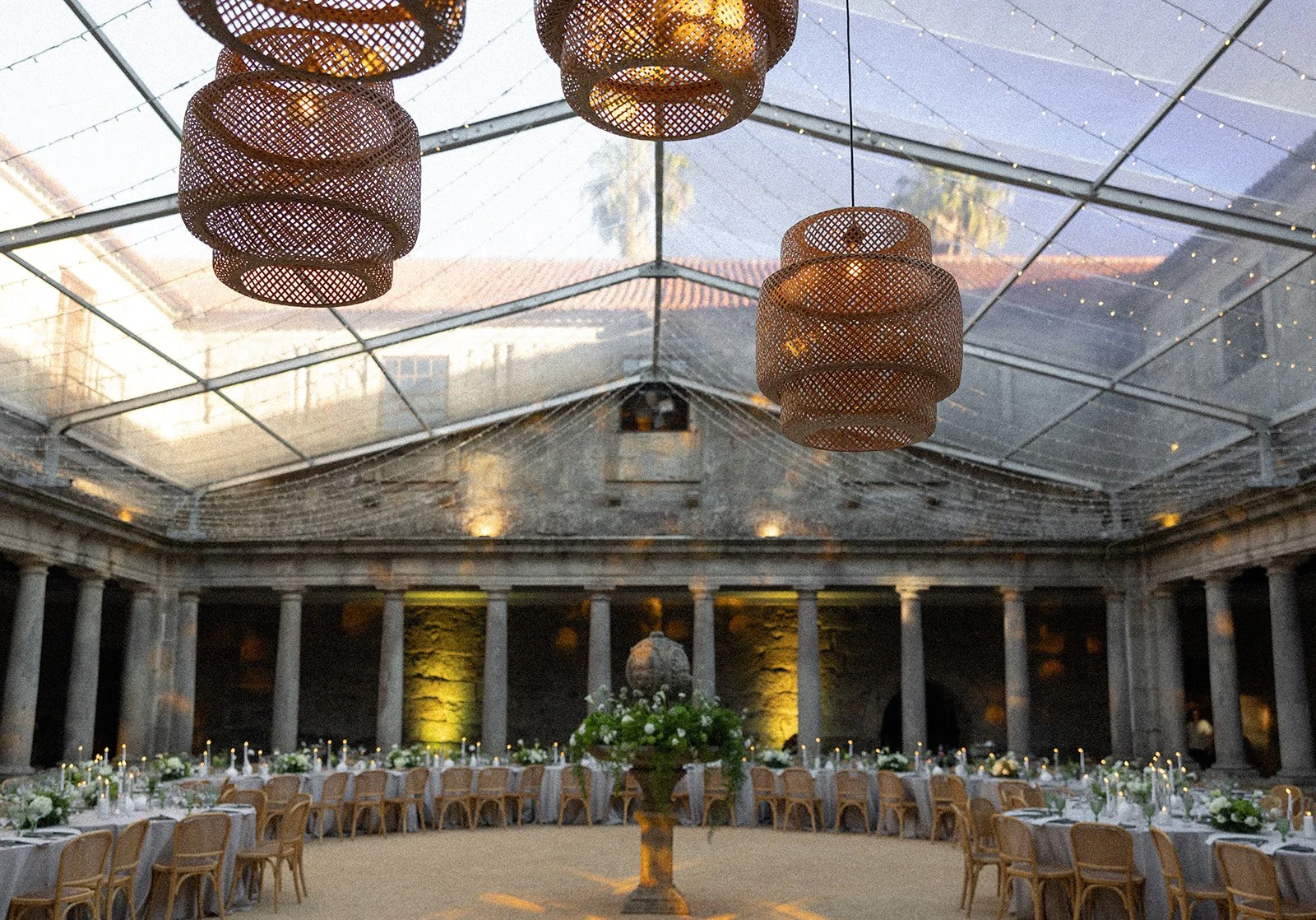
The main ceremony space is the cloister, which can accommodate between 150 and 300 guests beneath open stone column corridors surrounding a central grassed area. Two adjacent interior halls are available for receptions; one features an 18th-century carved wooden ceiling, created by craftsmen who also worked at the Monastery of Tibães. The 14th-century gardens contain camellias, rhododendrons, azaleas, and mature palm trees.
The cloister produces a specific quality of light: enclosed on all four sides by stone columns, it receives direct overhead light at midday and angled light through the colonnades in the morning and afternoon. The garden and the cloister entrance photograph consistently in the hours between 10 am and 2 pm, before hard ground shadows develop. The church and the reception space are side by side, which reduces the guest movement that larger, more spread-out properties require between ceremony and dinner.
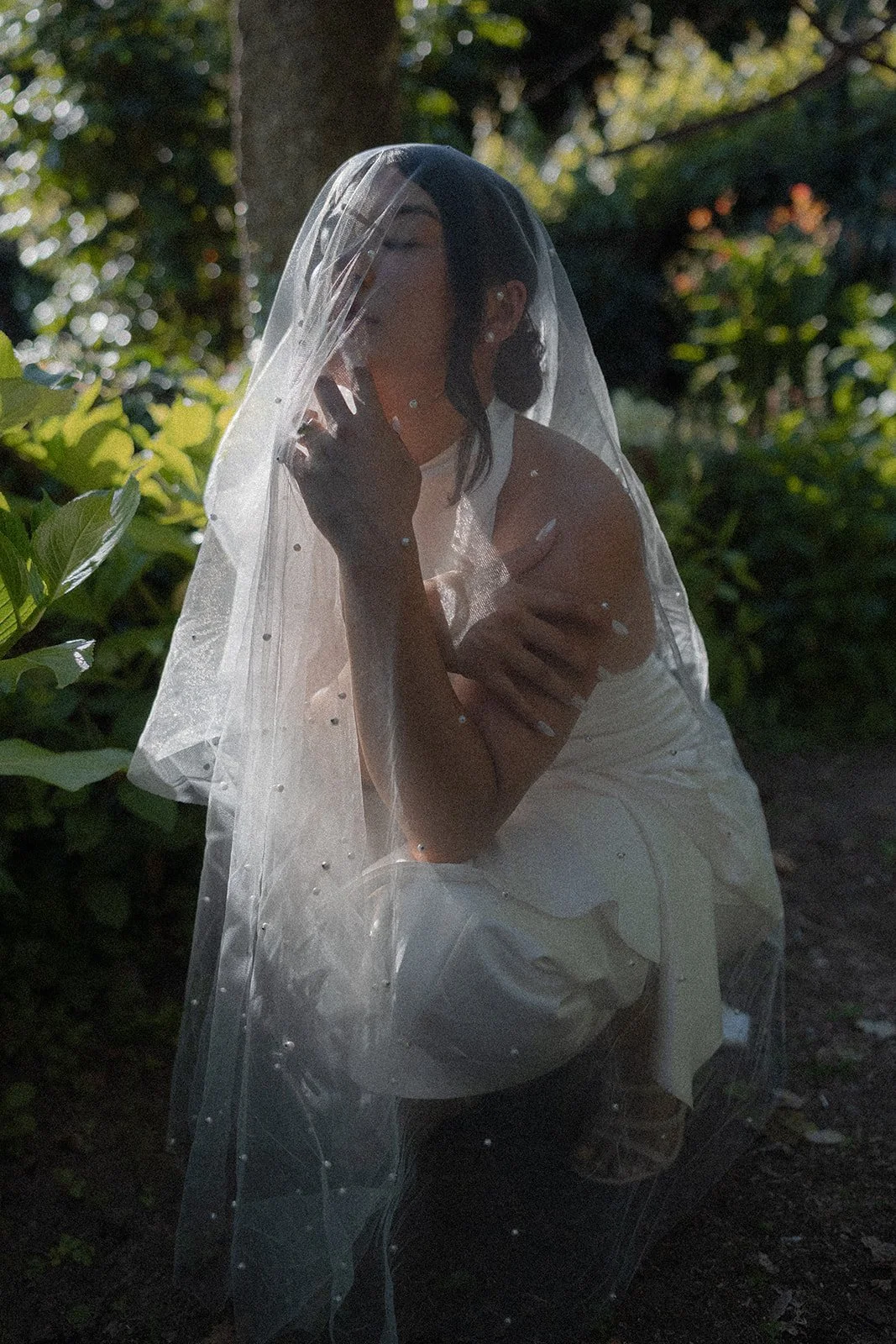
We photographed a three-day wedding here for Celine and Jack, with the welcome events in Porto and the main ceremony and reception at the monastery. The enclosed scale, the carved stone, and the specific quality of the cloister and garden light produced frames that are distinct from what we make at Atlantic coast venues.
Quinta Lago dos Cisnes, Amares
Quinta Lago dos Cisnes sits on the banks of the Cávado River in Amares, in the Minho, associated with the Solar da Levada, a manor building dating to 1710. The garden runs down to the river through a staircase entrance that couples use for the ceremony approach, and the grounds include a lake used for moments like the cake cutting. The property hosts one event per day and holds up to 350 guests, larger than most of the estate venues on this list, with catering handled exclusively in-house rather than through outside vendors.
One detail worth knowing if you are planning a long reception: the venue's closing time runs later than most Portuguese quintas, to 4 am rather than the more typical 1 am to 2 am, according to the venue's own booking information. For couples building a full night of dancing into the timeline, that extra window changes what's possible later in the evening.
We have not yet photographed at Quinta Lago dos Cisnes ourselves, so we're not going to speak to how the light behaves there across the day the way we can for the venues above, where that comes from direct experience. What we can say, from the property's own photographs and from other photographers' work there, is that the river setting and the staircase garden entrance give it a distinct character worth knowing about if you're considering the Minho.
When to Photograph in Northern Portugal
September and October are the strongest months for wedding photography in northern Portugal. The sun is at a lower angle than in summer, outdoor ceremonies are comfortable, and the Douro Valley enters harvest season, which adds the activity of the vineyard to portrait possibilities that do not exist at other times of year.
The critical difference from Atlantic coast timing is when to schedule ceremonies. A 5 pm ceremony that works well at a west-facing coastal venue may have flat shadow by 5:30 pm at a Douro Valley quinta, as the western hills intercept the sun earlier than a clear-water horizon would. North Portugal ceremonies that require strong natural light are better scheduled between 2 pm and 4:30 pm in autumn.
Morning sessions, from 7 am to 10 am, work in ways that coastal morning light does not replicate. River mist over the Douro, low-angle light through vineyard rows, cool early air with long shadows across stone: these are distinctive to northern valleys and are not available in the same form at Algarve or Comporta properties.
For multi-day format considerations across Portugal's regions, our guide to Portugal's best regions for multi-day wedding celebrations covers the north alongside Alentejo and the Algarve. For estate properties across all regions, our guide to private estate wedding venues in Portugal covers the full range.
Frequently Asked Questions
Are wedding venues in northern Portugal more or less expensive than Lisbon or the Algarve?
The range is similar across regions. Luxury hotel properties like Six Senses Douro Valley operate at rates comparable to five-star venues in Lisbon and the Algarve. Manor houses and estate properties in the Minho tend to have lower minimum spends than equivalent properties near Lisbon. The practical cost difference most couples notice is in guest travel: the north is served by Porto Francisco Sá Carneiro Airport, which has direct connections from major US and UK cities.
Does the Douro Valley work for international destination weddings, or is it primarily a local market?
The Douro Valley has been an active destination wedding region since the mid-2010s and receives a high proportion of international couples, particularly from the UK, the US, and Australia. The wine estate setting, the multi-day format that the region naturally encourages, and the harvest season timing in September and October make it a consistent choice for destination couples. Venues like Six Senses Douro Valley are designed specifically for international destination weddings rather than primarily serving local demand.
How far is northern Portugal from Lisbon?
Porto is approximately 310 kilometers north of Lisbon and is served by its own international airport. Most Douro Valley venues are between 80 and 150 kilometers northeast of Porto. Guests flying from the US, UK, or Australia can route through either Porto or Lisbon depending on available direct connections, and the choice between the two airports is generally a question of region preference rather than accessibility.
How does the light in northern Portugal compare to the Algarve or the Atlantic coast?
Northern Portugal's river valleys produce a different kind of light from the Atlantic coast. The surrounding terrain intercepts the descending sun earlier than an open water horizon would, which means the evening golden hour in the north arrives and ends earlier. Morning light, by contrast, is often stronger in northern valleys than on the coast: river mist, low-angle light through vineyard rows, and stone architecture that responds to early diffused light produce photographs specific to this landscape. The two regions are not interchangeable, and the approach to timing and positioning is different in each.
What does The Lopes Photography charge for a destination wedding in northern Portugal?
Our collections begin at 10,000 euros. We photograph ten weddings per year. For multi-day destination weddings in the Douro Valley, the Minho, or Porto, the timing, approach, and light windows are different from what we use at Atlantic coast venues. You can reach us through our contact page to discuss your specific dates and location, and we respond within 48 hours.
Working With Northern Light
After more than a decade photographing destination weddings across Portugal, Italy, and France, with work published in British Vogue, Vogue Arabia, Vogue Australia, and Tatler, our experience with northern Portugal's venues is that they reward a different way of working. The light is not better or worse than the Atlantic coast. It arrives differently, peaks at different times, and works within different architectural and landscape conditions.
The venues above are the ones we consider strongest across the Douro, Porto, and the Minho, chosen for their historic architecture, verified landscape character, and the consistency with which they photograph when the timing and approach are suited to northern light.
If you are planning a wedding in northern Portugal and want to discuss how the light works at a specific venue or during a specific month, reach us through our contact page. For the venues across Portugal's western Atlantic coast and southern plains where the evening golden hour is longest, our guide to the best natural light wedding venues in Portugal covers those properties in detail.
