
THE BEST NATURAL LIGHT WEDDING VENUES IN PORTUGAL
After photographing more than sixty weddings across Portugal, Italy, and France, with work published in British Vogue, Vogue Arabia, and Tatler, we have noticed something consistent: the venue that photographs best is rarely the one with the most elaborate decor. It is the one where light arrives from the right direction and stays that way for two or three hours.
The best natural light wedding venues in Portugal share three qualities: they face west or southwest to catch the descending sun, they sit at elevation or beside open water to keep the horizon unobstructed, and they have ceremony areas open enough to let light move freely rather than scatter and flatten.
Applied consistently across Portugal's geography, these three criteria produce a specific pattern. The strongest natural light venues are concentrated on the country's western Atlantic coast and its flat southern plains, not because northern Portugal is less photographically interesting, but because its enclosed river valleys and mountain terrain produce a structurally different kind of light. When the sun sets over the Douro Valley or the Lima River, the surrounding hills intercept it before the golden hour has fully developed. The result can be beautiful, but it is valley light: directional, cut short, and dependent on positioning in ways that open Atlantic horizon light is not. That landscape and its venues deserve their own guide.
The venues below are built on a different logic: open horizons, Atlantic exposure, and a sun that sets over water with nothing in the way.
What Makes a Venue Good for Natural Light?
The best venues for natural light in Portugal share three characteristics. They face west or southwest, so the last two hours of daylight fall directly into the frame rather than from the side or behind. They sit at an elevation or beside open water, which keeps the horizon clear and prevents hills or buildings from cutting off the golden hour before it peaks. And they have ceremony and portrait areas open enough that light moves freely, rather than bouncing off walls and losing its direction.
What these criteria produce, geographically, is a map of Portugal's western coastline and southern plains. A west-facing Atlantic venue sees the sun descend directly over the water: the longest, most unobstructed path it can take. Flat terrain in the Alentejo or Comporta means the horizon stays clear even as the sun drops to within one or two degrees of it. Enclosed inland valleys, by contrast, lose the sun behind their own ridgelines while it still has an hour or more of travel left.
Most of the venues on this list meet all three criteria. The few that meet two of the three still perform significantly better than average.
Fortaleza do Guincho, Cascais
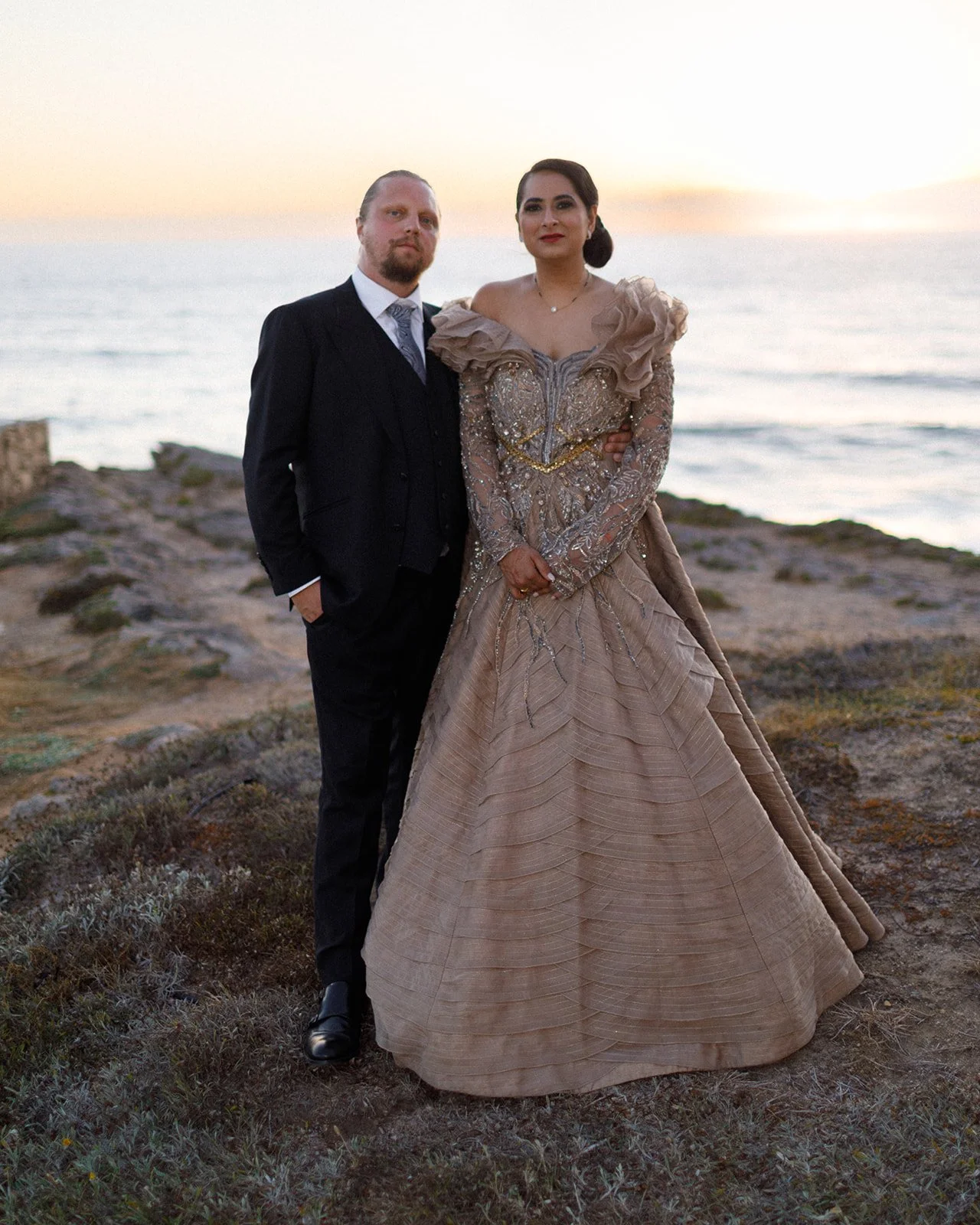
Fortaleza do Guincho sits on the Atlantic coast at the western edge of the Sintra-Cascais Natural Park, roughly 30 kilometers from Lisbon. The fort is a converted 17th-century military structure with stone walls that face the ocean directly.
The venue has an unobstructed western exposure. When the sun begins its descent over the Atlantic in summer around 6 pm, and in autumn closer to 5 pm, the light hits the stone and turns it amber. Portrait sessions between 6:30 pm and 7:30 pm in September and October here require nothing added to them. The light does the work.
Wind is a real factor at Guincho. The fort sits on an exposed promontory, and the westerlies arrive unimpeded. For veils, loose fabrics, and outdoor decorative elements, your coordinator will need to account for this. From a photography standpoint, the movement adds rather than detracts.
We have photographed at Fortaleza do Guincho multiple times. Most recently with Ekta and Ryan, for a multi-day Indian destination wedding that spanned the Mehndi ceremony, a welcome pool event, and the main Versace bridal ceremony. In each session, the late-afternoon light on the Atlantic cliffs produced the strongest portraits of the week.
Cascais is 30 kilometers from Lisbon along the A5.
Palácio de Queluz, Sintra
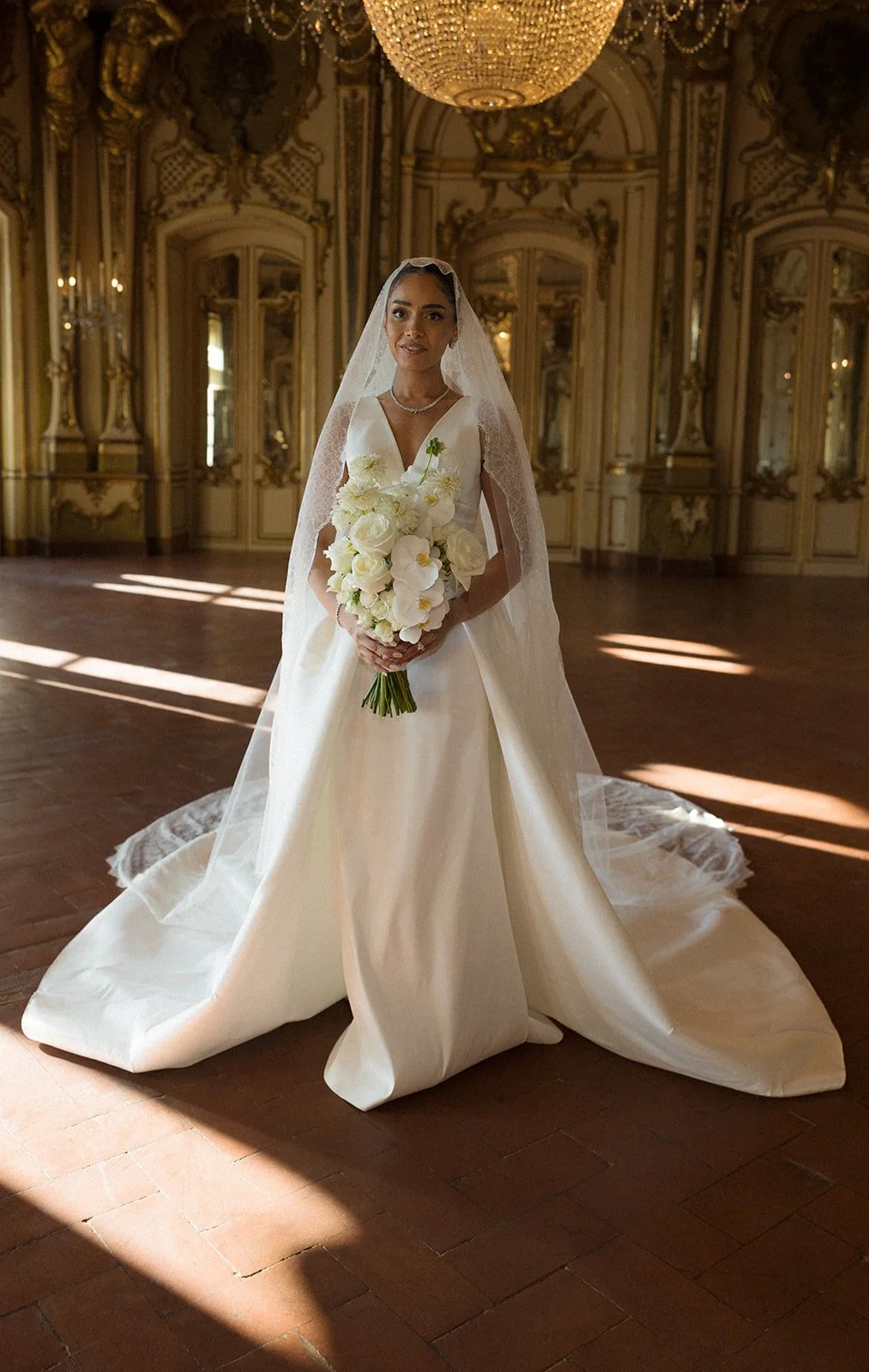
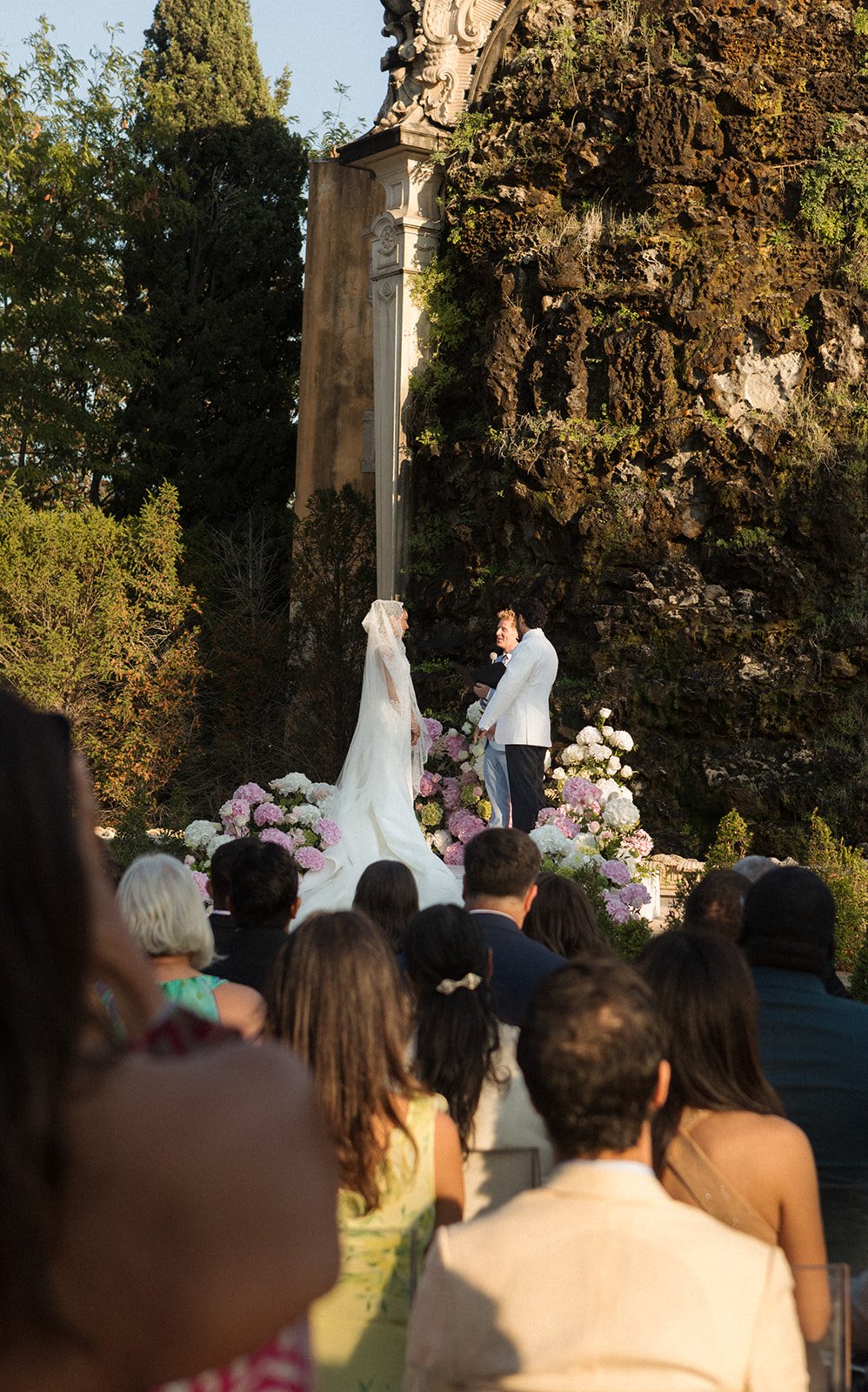
Palácio de Queluz is an 18th-century baroque palace in Queluz, within the Sintra municipality, on the western outskirts of Lisbon. The formal French-inspired gardens face north and northwest, with geometric boxwood parterres, fountains, and statuary.
The north-facing orientation has a specific consequence for photography: the light that reaches the garden during late-afternoon ceremonies never arrives overhead. It comes in at an angle. In September and October, golden light enters the garden from approximately 5 pm onwards, when the sun has moved past the harsh midday position and shadows are long rather than flat.
Inside the palace, the state rooms and ballroom have tall north- and west-facing windows. On overcast autumn days, which are common near Sintra, this produces soft, even light inside the building with no hard contrast. On clear afternoons, the west light enters the ballroom directly and creates warm, directional illumination.
We photographed a full wedding here for Hessah and Ali, a Middle Eastern destination wedding later published in Vogue Arabia. The garden ceremony light in late September was consistently what the images were built around.
Queluz is 15 kilometers from central Lisbon.
Comporta Private Estates
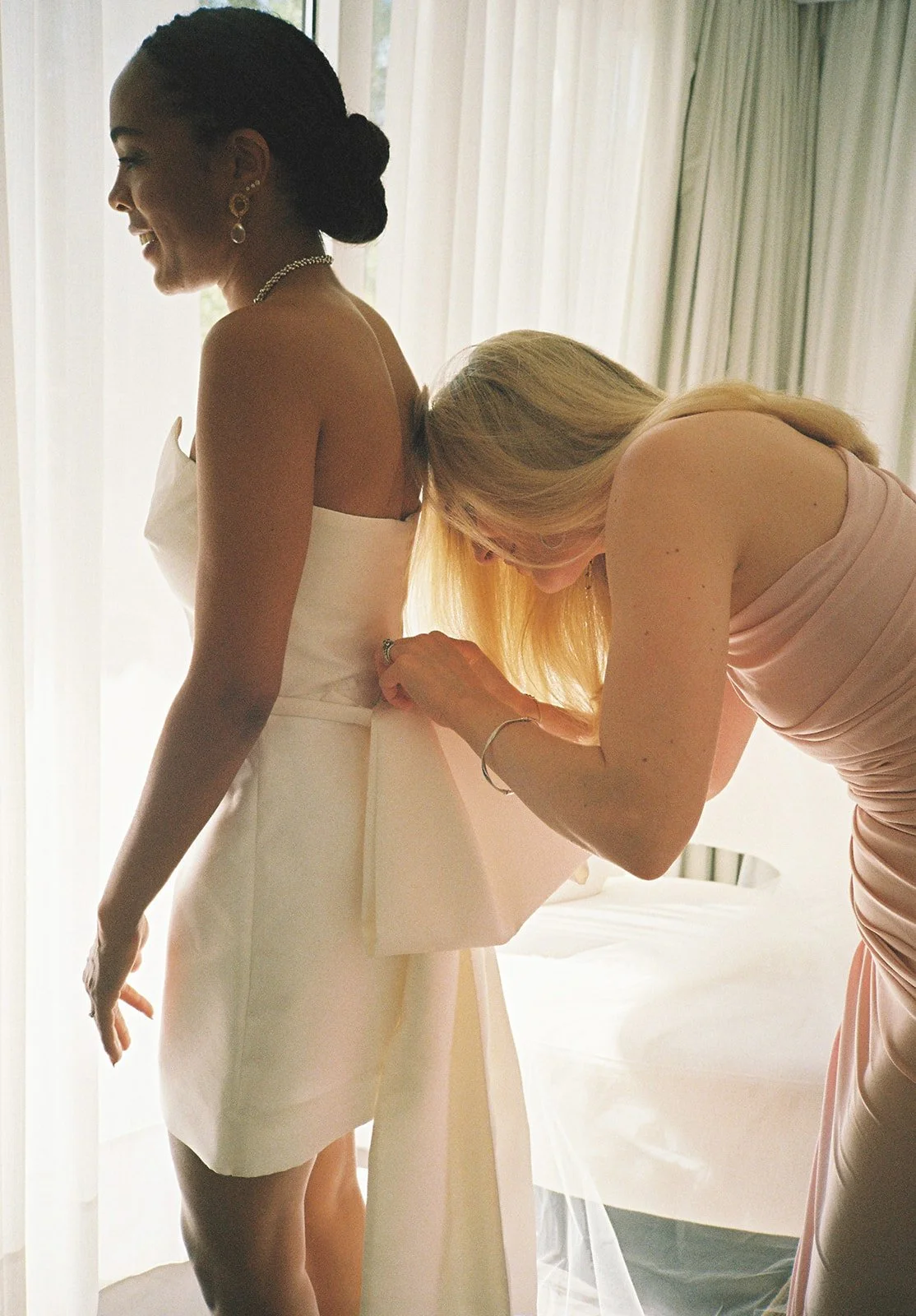
Comporta occupies a narrow peninsula on the southern shore of the Sado Estuary in the Setúbal district. The area is characterized by pine forests, rice paddies, and low dunes. There are no tall buildings and no hills that intercept the horizon. The sky is fully open in every direction.
This produces a distinctive quality of light. The flat topography means the sun sets over a clean, unobstructed horizon rather than disappearing behind a ridge or a row of buildings. Morning light arrives early and travels low and warm across the pines. Evening light lingers longer here than almost anywhere else on the Portuguese coastline.
Comporta weddings typically take place at private estates and villa properties. We photographed Laura and Alex's wedding here, including film photography in the villa's natural window light and portrait sessions in the estate gardens. The villa architecture uses whitewashed walls that reflect and diffuse light rather than absorb it. The film work at Comporta produced some of the most naturally luminous frames in that series.
Comporta is approximately 120 kilometers south of Lisbon.
Penha Longa Resort, Sintra
Penha Longa Resort sits within the Sintra Natural Park, on a hillside that faces south and west. The estate grounds slope toward the coast, with the Sintra hills providing a natural windbreak behind.
The south-facing ceremony areas receive afternoon light that arrives at a low enough angle to be flattering even in summer. The natural topography and the forest canopy above the gardens provide shade during midday, then open up to let the late-afternoon light through as the sun moves west. This is one of the few venues near Sintra where a 3 pm ceremony in August can still produce strong portraits without requiring constant repositioning.
The estate has multiple garden areas at different elevations, which allows the photographer to move between fully lit and shaded positions as conditions shift through the reception.
Sintra is 28 kilometers from Lisbon via the IC19.
Herdade da Malhadinha Nova, Beja
Herdade da Malhadinha Nova is a wine and rural tourism estate in the Beja district of the Alentejo. The Alentejo occupies the plains between the Tagus River and the Algarve, and Malhadinha sits within its characteristic flat, open farmland.
No hills block the horizon in any direction from this estate. Cork oaks and low shrubland mark the landscape. The consequence for photography is that the golden hour arrives and lasts longer here than almost anywhere else in Portugal, because there is nothing to prevent the sun from continuing to illuminate the ground as it descends. In September and October, warm light at Malhadinha begins around 6 pm and can extend to well past 7:30 pm.
The Alentejo also produces a specific quality of morning light. The sun travels through a longer, denser column of atmosphere over flat plains than it does on the coast, which warms and diffuses the light before it arrives. Morning portrait sessions in the Alentejo work in a way that coastal morning light rarely does.
Beja is 180 kilometers southeast of Lisbon on the A2.
Vila Vita Parc, Armação de Pêra
Vila Vita Parc is a resort on the cliffs above Armação de Pêra in the Algarve. The property sits at the cliff edge with direct views south over the sea, and ceremonies and portrait sessions at the resort face the water directly.
The Algarve has approximately 3,300 hours of annual sunshine, the highest of any Portuguese region. At Vila Vita, the light arrives from the south and reflects off the water below the cliffs. Portrait sessions benefit from both direct light from above and secondary fill light reflected from the sea, a combination that produces a warmth distinctive to this stretch of the southern coast.
The stronger southern sun means that ceremony timing is more critical here than at northern venues. A 5 pm or 6 pm ceremony in summer is preferable to midday. In October through April, even a 3 pm ceremony can produce flattering light. For couples considering a winter or early-spring wedding in Portugal, the southern Algarve is consistently the strongest region for natural light volume and quality across the whole year.
Armação de Pêra is in the Silves municipality, approximately 60 kilometers west of Faro.
When Does the Light Peak in Portugal?
September and October deliver the best light across all Portuguese regions for wedding photography. The sun is at a lower angle than in summer, temperatures allow for outdoor ceremonies without heat distortion in photographs, and the venues are quieter than in peak July and August. In the Alentejo and Comporta, the first autumn rains return green to the landscape, which helps photographs at those venues considerably.
July and August produce the harshest direct light, but a 5 pm or 6 pm ceremony at a west-facing venue like Fortaleza do Guincho or Vila Vita Parc means the strongest light arrives precisely at ceremony time rather than overhead. This is one of the practical advantages of a west-facing coastal venue for summer dates.
For film photography specifically, the overcast autumn days that arrive with the Atlantic cloud cover near Sintra produce some of the most evenly exposed frames we make in a given year. The film responds to consistent, diffused light in ways that direct, hard sun does not produce.
For more on timing your wedding around the Portuguese climate, see our guide to the best regions for a multi-day wedding in Portugal.
Frequently Asked Questions
What is the best time of day for wedding portraits in Portugal?
Between 5 pm and 7:30 pm, from April through October. This window produces directional, warm light without the hard shadows created by an overhead sun. At west-facing Atlantic venues like Fortaleza do Guincho, the golden hour is particularly concentrated: the light arrives directly from the sea, strikes the stone architecture, and produces warm amber tones for approximately 90 minutes before sunset.
Which region of Portugal has the most consistent natural light for weddings?
The Algarve has the highest volume of annual sunshine, making it the most reliably clear. For quality of light rather than volume, the Comporta peninsula and the Alentejo plains consistently deliver the most distinctive results. The flat landscape creates long, unobstructed golden hours. Sintra and the greater Lisbon area produce softer, often diffused light from Atlantic cloud cover that works particularly well for film photography and indoor palace sessions.
What about wedding venues in northern Portugal and the Douro Valley?
Northern Portugal and the Douro Valley are photographically exceptional — but for reasons that differ from the venues on this list. In the Minho and Douro, the light works within enclosed river valleys framed by terraced hills. That terrain produces a different kind of light: softer on the valley floor, and earlier to disappear in the evening as the surrounding ridgelines intercept the sun before it has fully set. The result can be extraordinary, but it requires different timing, different positioning, and a different photographic approach than the open Atlantic horizon venues above. We cover the best venues for that landscape in a separate guide to wedding venues in northern Portugal.
Does the direction a venue faces really affect wedding photography that much?
It is one of the most consequential decisions in venue selection. A west-facing venue in Portugal in September delivers light that needs nothing added between 5 pm and 7 pm. An east-facing venue at the same hour will have the couple standing in flat shadow with a bright sky behind them. No amount of decor compensates for that.
What does The Lopes Photography charge for a destination wedding in Portugal?
Our collections begin at €10,000. We photograph ten weddings per year, which allows us to give each wedding the time and attention it requires. You can reach us via our contact page, and we respond within 48 hours.
Working With the Light
After a decade of photographing destination weddings across Portugal, Italy, and France, with work published in British Vogue, Vogue Arabia, Vogue Australia, and Tatler, our position on venue selection is straightforward: light is not a detail. It is the medium.
The venues on this list are not all the most famous in Portugal. Several are not even the most expensive in their region. They are the ones where light consistently arrives in a way that produces strong photographs. Decor does not compensate for poor light. The right venue does not require compensation.
If you are choosing a venue and want to discuss how the light works at specific locations for your dates, we are glad to talk through it. You can reach us via our contact page or see examples of how each type of light translates to the final images in our Portugal wedding photography portfolio.
For a broader look at venue options across the country, our guide to private estate wedding venues in Portugal covers the full range of estate options, and our roundup of the best venues for full weekend celebrations covers multi-day formats.
