
WEDDING VENUES IN LISBON: A DESTINATION PHOTOGRAPHER'S GUIDE
We are Rui and Savannah Lopes, a husband-and-wife photography team based in Portugal, photographing a maximum of ten destination weddings each year across Portugal, Italy, and France. Our work has been published in British Vogue, Vogue Arabia, Vogue Australia Weddings, and Tatler. Five of the venues below are places we have photographed directly. Where that is the case, we have described what we found from the inside.
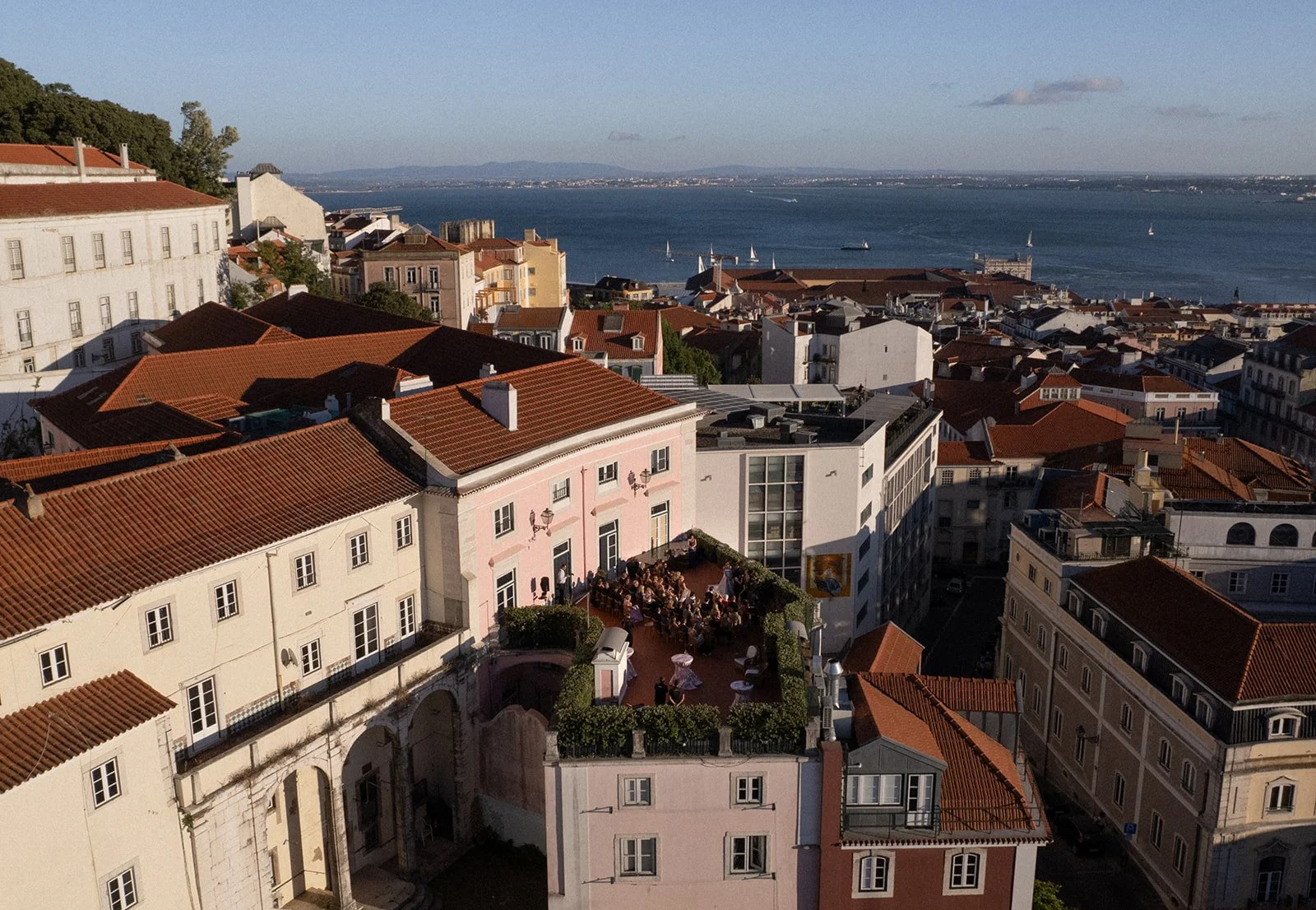
Lisbon is the most compact major destination on the western edge of Europe, and that compactness is part of what makes it function as a wedding city. Within the historic center, venues of completely different architectural characters sit within twenty minutes of one another. A baroque palace, a converted industrial space, and a nineteenth-century greenhouse are not separate propositions here. They are adjacent choices that couples evaluate against one another in the same week of research.
Photography and Light in Lisbon
September and October are the strongest months for wedding photography in Lisbon. The light is more directional and warm than in peak summer, temperatures settle between 20 and 26 degrees Celsius, and the city is less congested than in July and August. May and June offer extended daylight running past eight in the evening and consistent mild conditions suited to outdoor ceremonies.
What the city does photographically comes from its Atlantic exposure and its topography. Lisbon faces south and southwest, and venues in the Mouraria, Alfama, and Ajuda neighborhoods hold a golden-hour window of forty-five minutes or longer from late spring through early autumn. The light drops slowly and changes color progressively, giving unhurried time for portraits after the ceremony concludes.
The white lime-washed buildings and blue azulejo tiles common to the historic neighborhoods reflect this late light in a way that fills shadows softly and adds warmth at street level. That combination of surface material and sun angle is specific to Lisbon and produces a quality in urban portraits that photographers describe in the same terms as studio fill light: present but not obvious.
One practical note: the midday period between noon and four in the afternoon in July and August is the most challenging to work with photographically. Couples planning summer weddings should structure the day so that portraits fall outside that window, which typically means an early ceremony or a late-afternoon start.
Grémio Literário
Founded in 1846, the Grémio Literário is a private members' literary club occupying a palace in the Chiado district of central Lisbon. It is one of the few venues in the city where the architecture carries genuine historical weight and active institutional function simultaneously. This building is used daily as a private club, not preserved as a cultural monument for event hire. The seven event spaces distributed across the property include the Luís XV Room in neo-baroque style, a restaurant room overlooking the Tagus, and a private garden with a stone fountain.
The grand winding staircase is among the most photographically strong architectural features at any venue in the city. Blue-and-white azulejo tile panels line the walls from floor to ceiling. A crystal chandelier hangs at the upper landing. A bronze page-boy statue stands on a pedestal at the base. The ornate white iron banister curves through three floors of circulation space. It is the kind of staircase that gives the bride's aisle entry the same architectural weight as the ceremony itself.
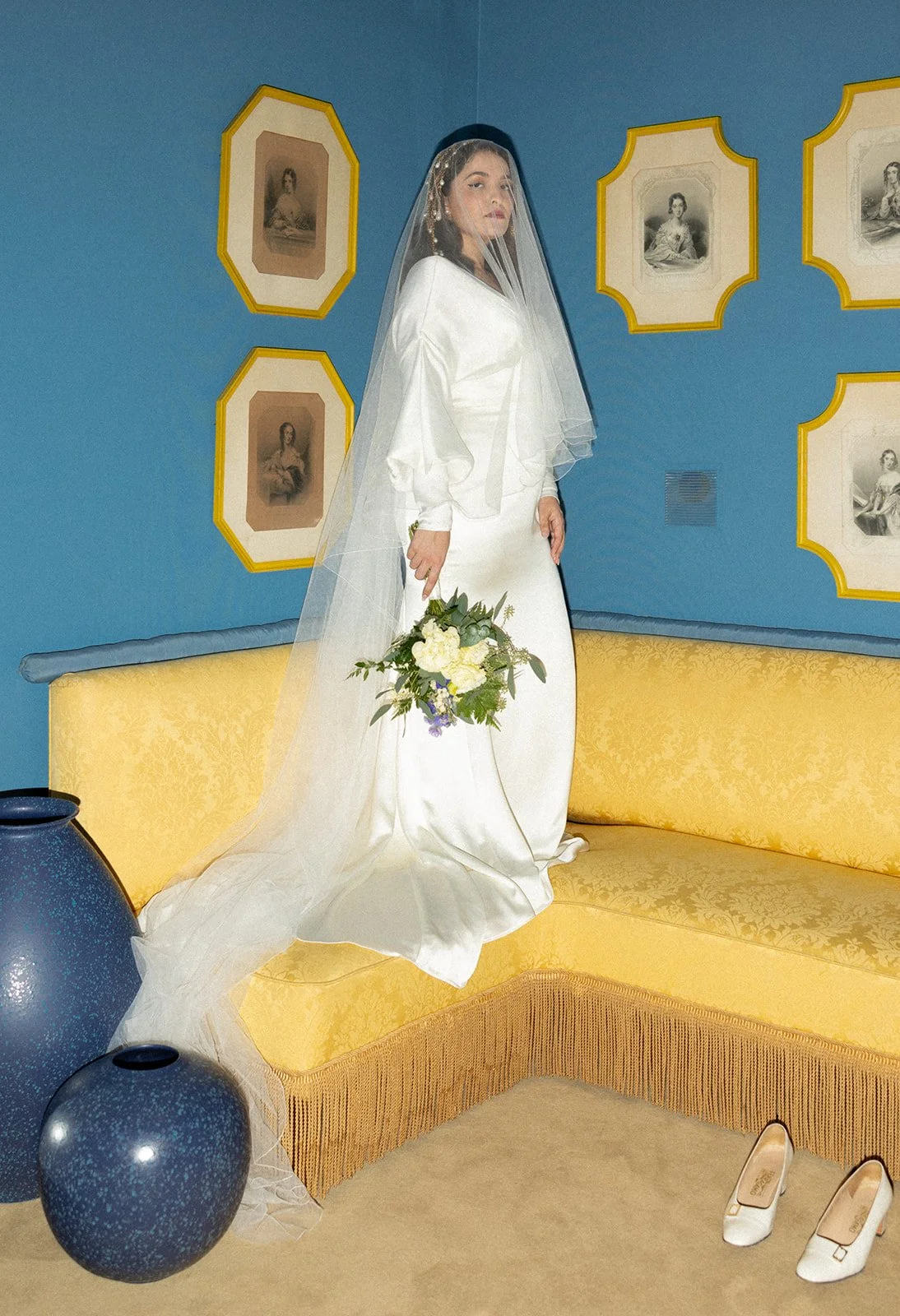
The reception moves through the salons on the piano nobile floor, where red damask wallpaper, Chesterfield chairs, framed oil paintings, and gilt-framed mirrors give the rooms a layered density that rewards slow, deliberate photography. The courtyard garden with its stone fountain provides a cocktail-hour setting that feels removed from the city outside.
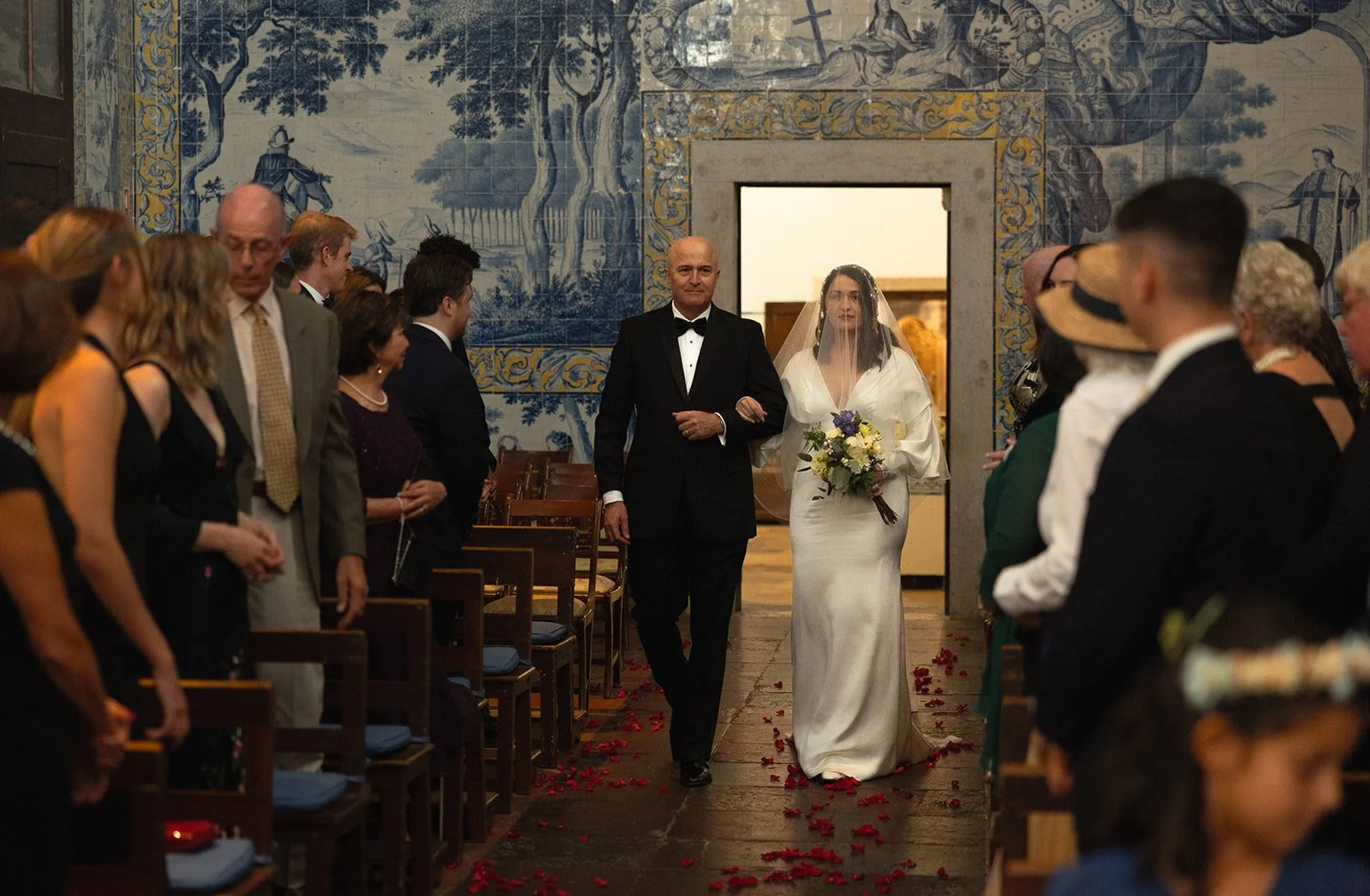
We photographed Catherine and Theodore's wedding at Grémio Literário, and the images were published in Vogue Australia Weddings. What the building does across a full wedding day is provide a sequence of completely different settings without any of the transitions feeling like relocations. The library, the staircase, the garden, and the salons each read independently. That variety matters when a wedding day moves through eight or nine hours of photography. See the full gallery: Catherine and Theodore at Grémio Literário.
For information: gremioliterario.pt
Palácio de Tancos
Palácio de Tancos stands in the Mouraria, at the foot of the Castelo de São Jorge. The building has origins in the sixteenth century, was transformed into a palace in the seventeenth century, and is one of the structures in the historic center that survived the 1755 Lisbon earthquake. The interior retains azulejo tile panels from the seventeenth and eighteenth centuries across three floors of event spaces. Outdoors, a patio with a swimming pool and a rooftop terrace with views across the city toward the Tagus give the property a range of settings that few Lisbon venues match at a single address.
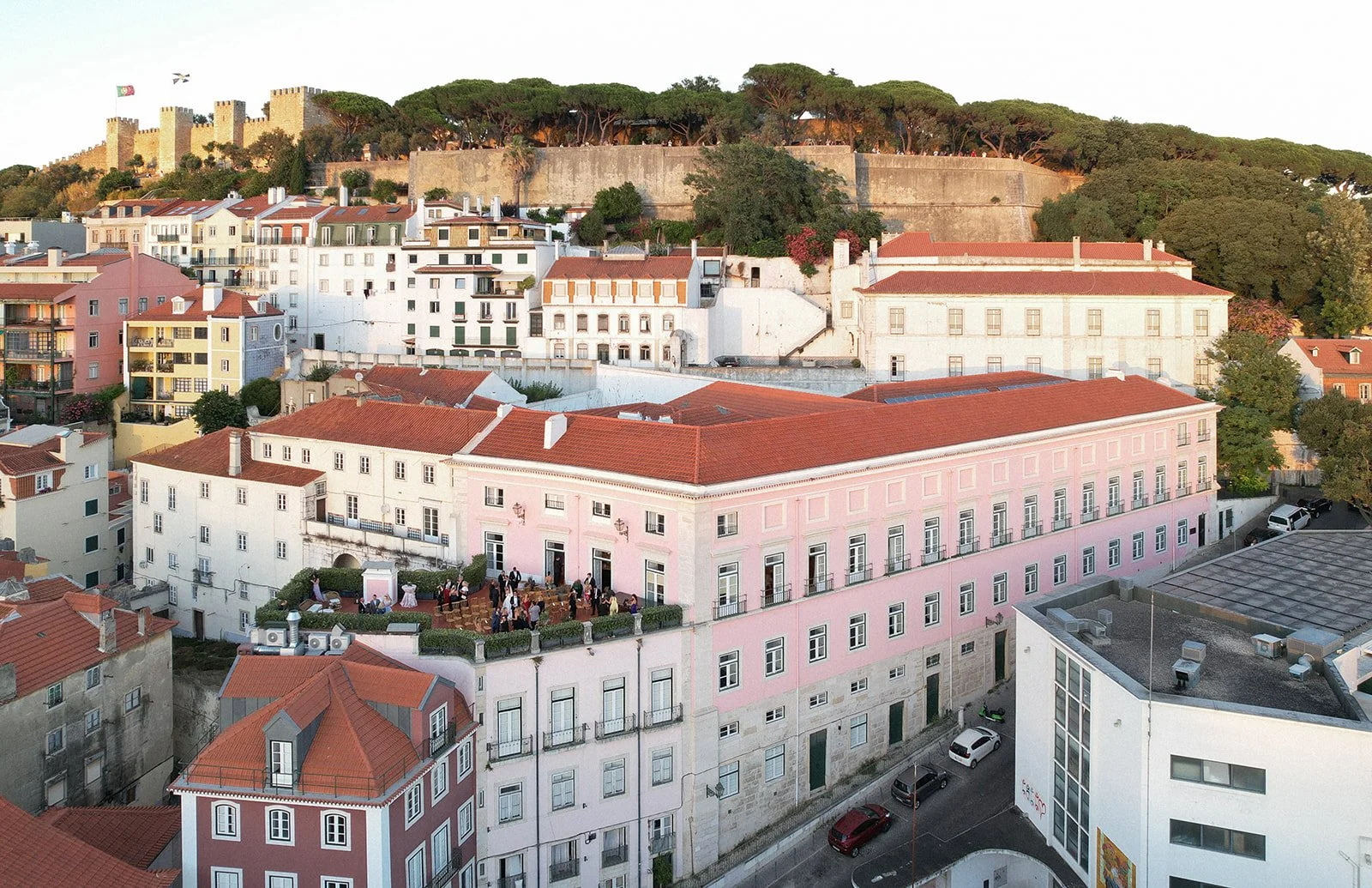
The rooftop ceremony is what this venue does that no other venue in the city center replicates at the same quality. The combination of the city skyline to the south, the castle directly above, and the Tagus visible in the distance produces a backdrop that changes as the afternoon light moves. What begins as bright, slightly flattening afternoon light shifts in the final forty-five minutes before sunset into the warm amber the city is known for photographically. Ceremonies timed for late afternoon take advantage of that transition naturally, without engineering it.
The property works particularly well for multi-day weddings. The combination of outdoor spaces, tile-lined interior rooms, and fourteen ensuite rooms on site means a group can stay, gather, and celebrate without relocating between properties. We photographed Baylee and Chad's three-day celebration here: a welcome event the night before, a poolside afternoon, and an evening reception that moved through nearly every space the property offers. See the full gallery: Baylee and Chad at Palácio de Tancos.
For information: palaciotancos.com
Pestana Palace Lisboa
A nineteenth-century palace in the Ajuda neighborhood in western Lisbon, the Pestana Palace operates as a five-star hotel with 193 rooms, formal gardens, and a full hotel events team. From the terrace gardens above the Tagus, the 25 de Abril suspension bridge is visible across the water, and that connection to the city's most recognizable landmark gives portraits at this venue an immediate geographic grounding that interior-only venues cannot provide.
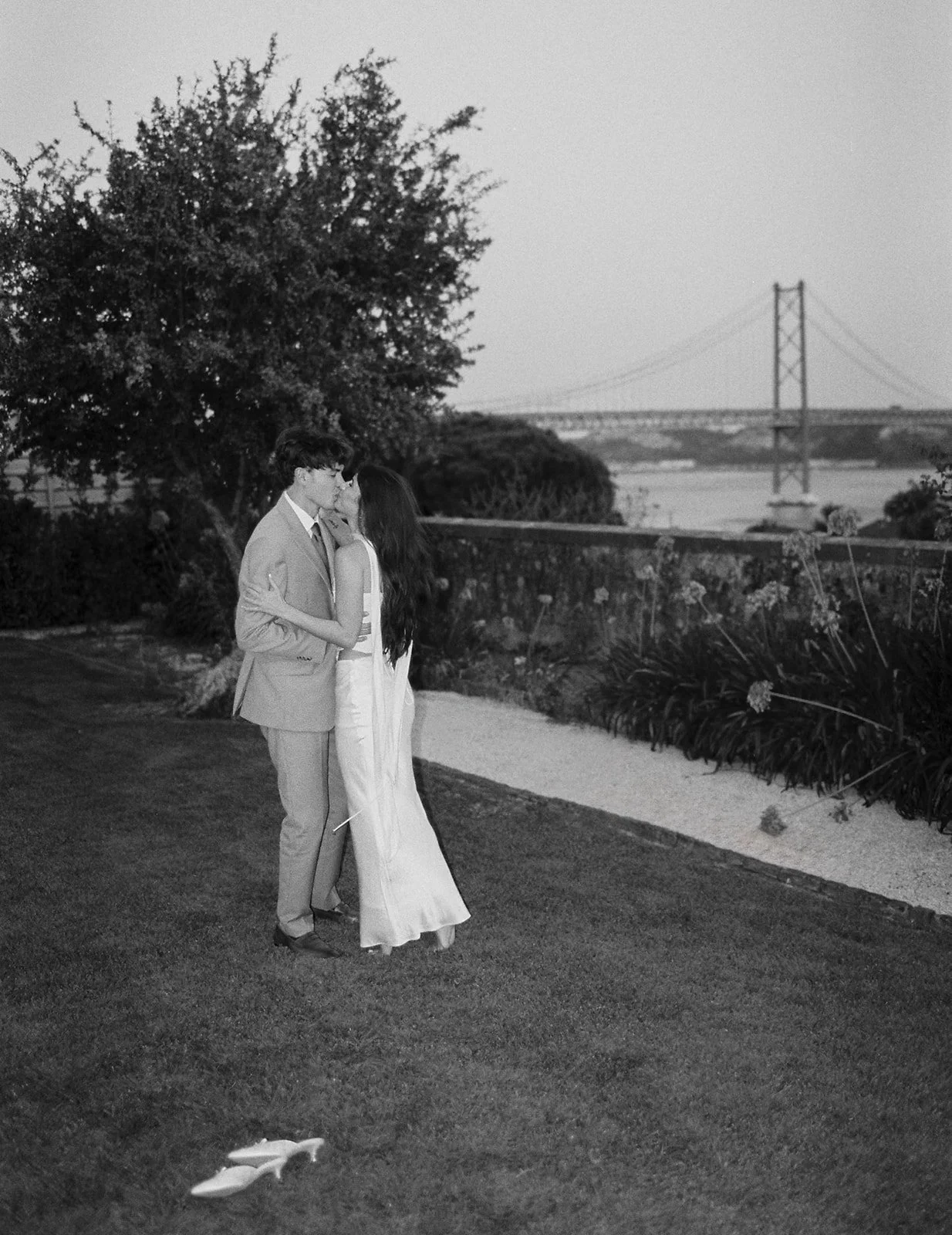
For international couples who need accommodation, catering, and event logistics managed by a single property without coordinating across multiple vendors, the hotel infrastructure at Pestana Palace is the primary operational argument in its favor. The wood-paneled dining rooms, stained-glass windows, and gilded interiors provide strong reception photography. The property's position above the city produces a quality of late-afternoon light in the formal garden that is softer and more directional than at river-level venues.
We photographed Trinity and Elijah's intimate destination wedding here. See the full gallery: Trinity and Elijah at Pestana Palace Lisboa.
For information: pestanacollection.com
Estufa Fria
Opened in 1933 and designed by architect Raul Carapinha, the Estufa Fria is a greenhouse and botanical garden set within Parque Eduardo VII, built on the site of an old basalt quarry. An iron lattice roof filters daylight into a garden of tropical and temperate plants, and the quality of light inside is unlike any other venue in the city. It is diffused and layered regardless of the time of day, because the lattice structure breaks direct sunlight into shifting patterns across the stone paths and the plant canopy below. Harsh midday light is not a problem at Estufa Fria the way it is at exposed rooftop or garden venues.
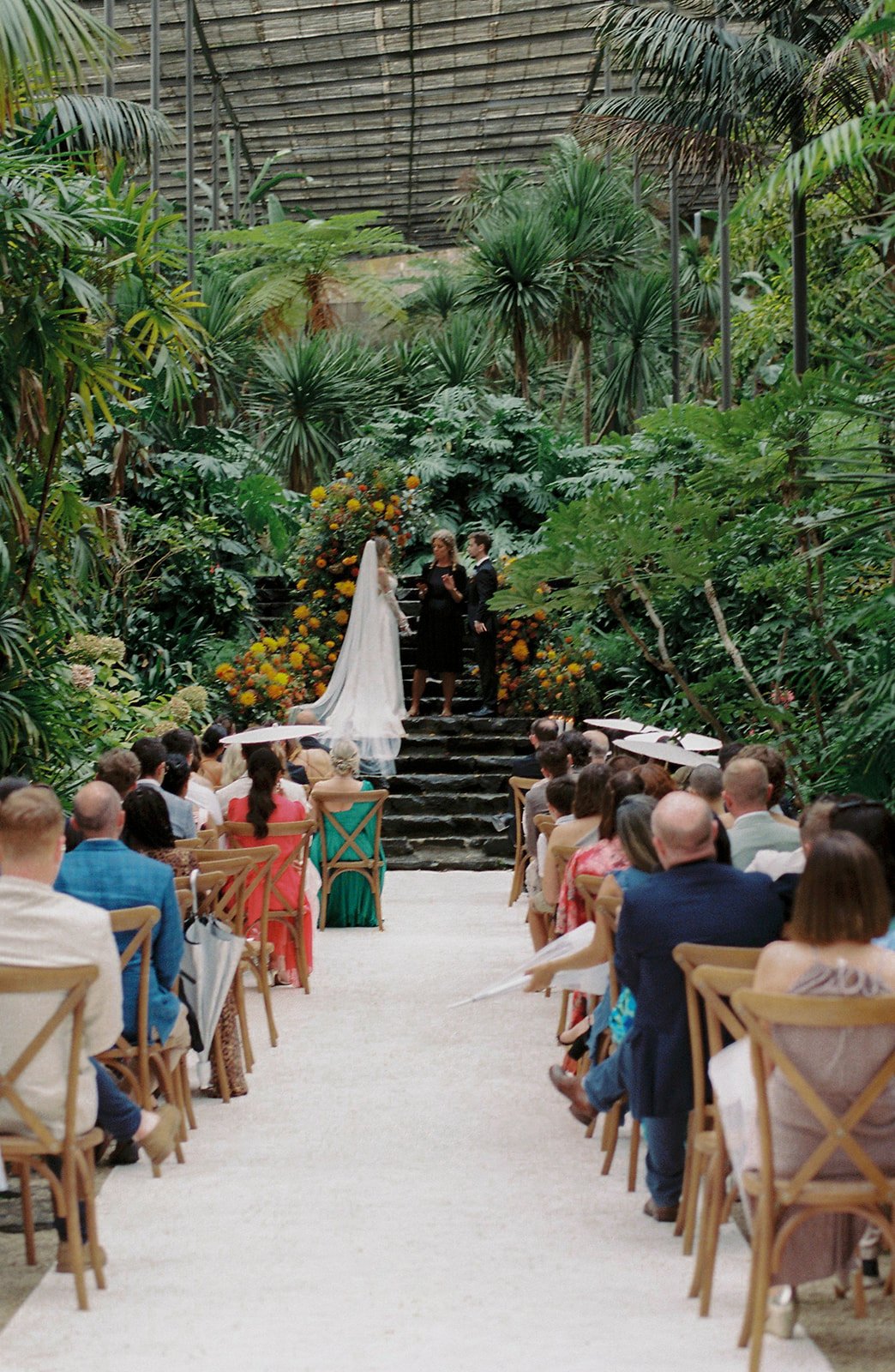
The Nave, the principal event space, spans 800 square meters within the greenhouse structure. The plant height, the iron framework overhead, and the stone paths between planting beds all provide compositional depth at any angle, which is a quality most event spaces lack entirely. The setting also changes visually depending on where the camera points: facing toward the ceremony, the backdrop is tropical vegetation and lattice light. Facing the other direction, it reads as industrial structure and shadow.
We photographed Giorgia and James's wedding here entirely on analog film. The diffused, layered light of the greenhouse is particularly well matched with film photography: the tonal range of film records the soft contrasts of this space differently from digital, and the images that came out of that day reflect the specific character of the venue in a way that would be harder to achieve with digital capture. See the full gallery: Giorgia and James at Estufa Fria.
For information: casadomarques.pt
La Distillerie
La Distillerie is in the Alfama neighborhood, at Campo de Santa Clara, directly across from the Panteão Nacional. The building is a converted industrial space, and the visual contrast between its interior character and the historic street and national monument it faces is a significant part of what makes it photographically distinct from the palace circuit. Couples who want a venue with the character of a specific Lisbon neighborhood rather than formal grand architecture tend to respond to it immediately: the building feels earned, rooted in a specific corner of the city.
We photographed Abigail and Matt's wedding here. See the full gallery: Abigail and Matt at La Distillerie.
For information: ladistillerie-lisbon.com
Further Venues Worth Considering
Palácio dos Marqueses de Fronteira
Located in the Benfica area near Monsanto Forest Park, the Palácio dos Marqueses de Fronteira has been in the same family since the seventeenth century and is one of the most architecturally significant private palaces in Portugal still in regular use. The formal gardens are lined with azulejo tile panels depicting mythological scenes and historical allegories. Reflecting pools framed by tiled balustrades create a visual identity that is impossible to replicate at any other venue in the country. Events here require direct negotiation with the family foundation and typically demand a longer booking lead time than most commercial venues. Couples for whom this setting is the right fit tend to know it early in their research.
For information: fronteira-alorna.pt
Convento do Beato
A former convent in the Beato neighborhood on Lisbon's eastern waterfront, the Convento do Beato is one of the city's principal options for larger weddings. The central cloister and the scale of the converted conventual buildings give gatherings a historical character that purpose-built event spaces rarely achieve.
For information: conventodobeato.com
Pousada de Lisboa
The Pousada de Lisboa occupies a historic building on Praça do Comércio, the grand eighteenth-century square directly on the Tagus riverbank. Its position at water level, with open light and estuary views across to the south bank, is a setting that connects portraits directly to the city's geographic identity. It is one of the few Lisbon venues where the immediate exterior is as visually significant as the interior.
For information: pousadas.pt
Verride Palácio de Santa Catarina
A nineteen-room boutique hotel occupying an eighteenth-century palace near the Miradouro de Santa Catarina, the Verride takes events as exclusive bookings, meaning the entire property is reserved for the wedding party. The scale suits intimate weddings and elopements particularly well. The rooftop terrace provides portraits with an unobstructed view across the city and river.
For information: verridesc.pt
Palácio Grilo, Palácio do Correio-Mor, and The One Palácio da Anunciada
Palácio Grilo is an eighteenth-century baroque palace in the Beato neighborhood that has undergone significant renovation while preserving its historic architectural character. It is increasingly chosen by couples who want a Lisbon palace experience in a context that is less saturated than the more established venues. Palácio do Correio-Mor, a baroque palace in Loures, a short distance north of the city, offers formal gardens and reception rooms suited to larger weddings that want the atmosphere of a country estate within easy reach of Lisbon. The One Palácio da Anunciada, operated by H10 Hotels in the Chiado area, suits smaller receptions and cocktail gatherings in a central location.
For information: palaciogrilo.com, palaciodocorreiomor.pt, h10hotels.com
What to Ask Before Booking
For any Lisbon venue: what is the installation window for florals and décor, and does it require the day before or only the morning of the wedding?
For venues operating as family estates or public monuments: what are the specific restrictions on ceremony installation and photography access in non-event areas of the property?
For hotel venues: are the bedroom blocks reserved exclusively for the wedding party, or are they available to the general public throughout the event period?
For outdoor rooftop ceremonies: what is the contingency plan if weather changes in the hour before the ceremony, and has that plan been activated before?
Any planner who works regularly in Lisbon should have direct answers to all of these before the contract is signed.
Frequently Asked Questions
What are the best months for a wedding in Lisbon?
September and October are the strongest months. The light is more directional and warm than in peak summer, temperatures are typically between 20 and 26 degrees Celsius, and venues are less congested than in July and August. May and June are strong alternatives, with daylight running past eight in the evening and consistent mild conditions well suited to outdoor ceremonies.
How far in advance should we book a Lisbon wedding venue?
For dates between May and October, plan to secure your venue at least eighteen months before the wedding. The smaller and more exclusive properties, particularly boutique hotels that take only one event at a time, are confirming dates two or more years out. Planning from abroad consistently takes more communication rounds than local planning, and the most-requested weekends fill first regardless of venue size.
Can foreign couples legally get married in Lisbon?
Foreign nationals can complete a civil ceremony in Portugal, but the documentation process is substantial, and the timeline from application to ceremony date can run six months or longer depending on country of origin. Many international couples choose to complete their legal marriage at home and hold a symbolic ceremony in Lisbon, which requires no Portuguese bureaucracy and no waiting period. A symbolic ceremony is conducted by a celebrant of the couple's choosing, follows whatever structure and vows the couple decides on, and is indistinguishable to guests from any other non-religious ceremony.
What does destination wedding photography in Lisbon cost with The Lopes Photography?
Wedding photography in Lisbon with The Lopes Photography starts at €10,000 for full-day coverage. We photograph ten weddings per year across Portugal, Italy, and France, with work published in British Vogue, Vogue Arabia, Vogue Australia Weddings, and Tatler. You can begin your inquiry on our contact page.
Are there notable venues just outside Lisbon worth considering alongside these?
Yes. The municipalities within thirty to forty-five minutes of central Lisbon include properties that destination couples evaluate seriously alongside the city options. Sintra, in particular, has a concentration of remarkable venues, from eighteenth-century palace hotels in the old town to private estates in forested terrain, that draws serious consideration from couples who are not restricted to the city. Our separate guide to Sintra wedding venues covers those options in detail.
After photographing over sixty weddings across Portugal, Italy, and France, and with work in British Vogue, Vogue Arabia, Vogue Australia Weddings, and Tatler, we have a perspective on what the choice of venue does to the photographs that goes beyond what any venue tour conveys: how the light moves through the rooms at different hours, what the building does in the transitions between spaces, and which moments the architecture makes available that could not have been planned for. If you are in the process of narrowing your list and want a conversation about what we have seen at any of these venues, we are glad to have it.
If you are also considering venues beyond Lisbon, our guides to wedding venues in the Algarve and Alentejo wedding venues cover the other main regions of Portugal.
